
Could the future of haircare be a little more scientific? From copper peptides to follicle-supporting actives, we're exploring the science behind topical peptides and their growing role in modern scalp care.
The growing interest in peptides and hair health
If you've spent any time researching hair thinning, shedding or ways to achieve fuller-looking hair, you've probably noticed a growing interest in peptides.
They're appearing in everything from advanced skincare to scalp serums, and for good reason. Peptides are fascinating little molecules that play important roles in how our bodies communicate, repair and maintain tissue.
But what exactly are they, and why are cosmetic scientists becoming so interested in using them in haircare?
To understand their potential, we first need to look beyond the hair strand itself.
Healthy-looking hair isn't simply about what happens on the surface. Each strand begins its life inside a hair follicle, a complex little structure within the skin that relies on communication between different cells, a healthy surrounding environment and a carefully regulated growth cycle.
This is where peptides become particularly interesting.
Rather than simply coating the hair to make it feel thicker or smoother, certain peptides are being investigated for their ability to interact with biological processes associated with the hair follicle and the surrounding scalp environment.
And perhaps one of the most interesting parts of this conversation is the difference between encouraging hair growth and supporting hair retention. Because growing new hair is only part of the picture. Keeping the hair you already have matters just as much.
Let's get into the science.
First things first: What exactly are peptides?
Peptides are short chains of amino acids, which are the building blocks of proteins.
You can think of amino acids as individual building blocks, peptides as small groups of those blocks joined together, and proteins as much larger structures made from amino acid chains.
Our bodies naturally produce thousands of different peptides, and they have a variety of functions. Some act as signalling molecules, helping cells communicate with one another. Others are involved in tissue maintenance, immune responses and repair processes.
In skincare and haircare, scientists have become particularly interested in bioactive peptides.
These are peptides that can interact with specific biological processes or cellular pathways.
Rather than acting as a traditional moisturiser or conditioning ingredient, certain bioactive peptides are designed to act more like messengers, influencing how cells respond to their surrounding environment.
This is what makes them so interesting in modern cosmetic formulations.
However, not every peptide does the same thing. Their function depends on their individual amino acid sequence, structure and how they interact with biological systems.
A peptide that supports collagen-related processes in skin, for example, isn't automatically going to have the same effect on a hair follicle.
When it comes to haircare, the real interest lies in identifying peptides that may support the biological environment involved in healthy hair growth and retention.
How do peptides work on the scalp?
To understand why peptides are being explored for haircare, it's helpful to understand a little about the hair follicle.
A hair follicle isn't simply a tiny opening in the scalp. It's a complex mini-organ containing several different structures and cell types that work together to produce a hair strand.
One particularly important structure is the dermal papilla.
Located at the base of the follicle, the dermal papilla contains specialised cells that communicate with surrounding follicular cells and help regulate the hair growth cycle.
These cells are involved in signalling processes that influence hair growth, follicle development and the transition between different growth phases.
Another important component is the extracellular matrix (ECM).
The ECM is a network of proteins and other molecules surrounding cells. It provides structural support and helps regulate communication between cells and their environment.
Think of it as the scaffolding that helps hold everything together.
In the scalp, the extracellular matrix contributes to the structural environment surrounding the hair follicle.
Researchers are interested in whether certain peptides can influence these supporting structures and the signalling pathways involved in follicular health.
This is particularly interesting when discussing hair retention.
Rather than focusing exclusively on stimulating new growth, some peptide-based approaches investigate the biological environment surrounding existing follicles.
It's an exciting area of cosmetic science, although the precise effects depend on the peptide, its concentration, delivery system and the formulation in which it is used.
Growth vs retention: Why both matter
We often use the words hair growth and hair retention interchangeably, but they aren't quite the same thing.
Hair growth refers to the production of new hair from an active follicle.
Hair retention refers to maintaining the hair you already have, reducing avoidable loss and preserving the appearance of density and fullness.
Both are important when looking at overall hair health.
For example, someone might be experiencing increased shedding, gradual thinning or hair that seems to become progressively finer.
These concerns can have different underlying causes, including genetics, hormonal changes, nutritional deficiencies, stress, illness and certain medications.
The hair growth cycle also plays an important role.
Understanding the hair growth cycle
Hair follicles move through several distinct phases:
1. Anagen – The growth phase
This is the active growth stage, when cells within the follicle are producing the hair shaft. Scalp hair can remain in this phase for several years.
2. Catagen – The transition phase
A short transitional stage in which active growth stops and the follicle begins to regress.
3. Telogen – The resting phase
The follicle enters a resting period. Eventually, the existing hair is released and shed.
4. Exogen – The shedding phase
The old hair is released, allowing the cycle to continue.
Shedding is a completely normal part of this process. We naturally lose hair every day.
However, when the balance of the growth cycle changes, or more follicles enter the resting phase at once, increased shedding and visible thinning can occur.
This is why haircare research is looking beyond simply making hair grow faster.
Supporting the scalp environment, understanding follicular signalling and exploring ways to maintain healthy hair are all important parts of the bigger picture.
The two peptides worth knowing about
There are many different peptides being explored in cosmetic science, but two particularly interesting ingredients are GHK-Cu (Copper Tripeptide-1) and Acetyl Tetrapeptide-3.
Although both are used in advanced cosmetic formulations, they have different structures and proposed functions.
Let's look at what makes each one interesting.
1. GHK-Cu (Copper Tripeptide-1) – The copper peptide
GHK-Cu is a naturally occurring copper-binding tripeptide.
Its name comes from its three amino acids:
Glycine
Histidine
Lysine
When this short peptide binds to a copper ion, it forms the copper peptide complex known as GHK-Cu.
Copper is an essential trace element involved in several biological processes, including enzyme activity, connective tissue formation and normal cellular function.
The interesting part is how the peptide and copper work together.
GHK-Cu has been extensively investigated in skin science, particularly in relation to tissue repair, collagen-related processes, extracellular matrix remodelling and cellular signalling.
But what does that mean for hair?
Why is GHK-Cu interesting for scalp care?
Hair follicles rely on a complex network of surrounding cells and supporting structures.
The dermal papilla, connective tissue and extracellular matrix all contribute to the follicle's biological environment.
Laboratory research into copper-containing peptides has investigated their interaction with dermal papilla cells and follicular growth.
There is an important distinction here: one frequently discussed laboratory study used AHK-Cu, a related but different copper peptide, on isolated human hair follicles. It reported stimulation of follicle elongation and dermal papilla cell proliferation under specific experimental conditions.
This is interesting research, but AHK-Cu is not the same ingredient as GHK-Cu, and results cannot simply be transferred from one to the other.
GHK-Cu itself has a broader body of research relating to tissue biology and cellular signalling, but direct human evidence demonstrating that topical GHK-Cu alone produces hair regrowth remains limited.
So why is it attracting attention?
Because its potential involvement in tissue maintenance, extracellular matrix activity and cellular communication makes it an interesting ingredient to investigate in advanced scalp formulations.
It's not simply another conditioning ingredient. It belongs to a different category of cosmetic actives that researchers are exploring for their interaction with biological processes.
2. Acetyl Tetrapeptide-3 – The follicle-supporting peptide
Acetyl Tetrapeptide-3 is another interesting peptide used in modern haircare formulations.
As its name suggests, it contains four amino acids and has been developed for cosmetic applications involving the scalp and hair.
It's particularly associated with research into the extracellular matrix and the structural environment surrounding the hair follicle.
Remember that scaffolding we discussed earlier?
The extracellular matrix contains structural proteins such as collagen and laminin, which help maintain the surrounding tissue environment.
Acetyl Tetrapeptide-3 has been investigated for its potential involvement in supporting extracellular matrix-related processes.
This is particularly relevant when discussing the concept of hair retention.
What makes it interesting for hair retention?
Hair follicles don't operate independently of their surrounding tissue.
The structural environment around the follicle plays an important role in maintaining normal follicular function.
Research into Acetyl Tetrapeptide-3 has explored its relationship with extracellular matrix proteins and follicular support.
It is also commonly used alongside botanical ingredients, particularly red clover extract, in multi-ingredient cosmetic complexes.
One such combination has been investigated in a 24-week controlled clinical study involving people with mild to moderate androgenetic alopecia.
The combination contained Acetyl Tetrapeptide-3, biochanin A from red clover and ginseng extracts.
The researchers observed an increase in terminal hair counts over the study period.
However, because several active ingredients were combined, the results cannot establish how much of the observed effect came from Acetyl Tetrapeptide-3 alone.
This distinction is important.
There is promising research into peptide-containing hair formulations, but we still need more studies to understand the individual contribution of each ingredient.
Nevertheless, the relationship between Acetyl Tetrapeptide-3 and extracellular matrix research makes it an interesting ingredient in the development of targeted scalp treatments.
GHK-Cu vs Acetyl Tetrapeptide-3: What's the difference?
Although both ingredients are peptides, they aren't interchangeable.
They have different structures and different areas of scientific investigation.
GHK-Cu
A copper-binding tripeptide.
Investigated for tissue repair and cellular signalling.
Has research relating to collagen and extracellular matrix activity.
Interesting for its potential interaction with the biological environment surrounding follicles.
Acetyl Tetrapeptide-3
A four-amino-acid peptide.
Investigated in relation to extracellular matrix proteins and follicular support.
Commonly incorporated into multi-ingredient haircare complexes.
Has been included in clinical studies of combination hair formulations.
The interesting thing about using different peptides together is that they offer different areas of biological investigation.
Rather than assuming one ingredient does everything, modern formulation science looks at how different actives can complement one another.
Why topical delivery matters
Another important part of the conversation is how peptides are delivered.
You might wonder why we would apply peptides directly to the scalp rather than take them orally.
The answer comes down to the intended application.
Topical formulations are designed to be applied directly to the area being cared for.
A leave-in scalp treatment can provide regular contact between the formulation and the scalp, without relying on an ingredient being digested and absorbed through the gastrointestinal system.
However, topical delivery isn't quite as simple as putting an ingredient into a spray bottle.
The skin has a protective barrier, known as the stratum corneum, which regulates what can pass through it.
Peptides can present formulation challenges because their size, structure, water solubility and stability can affect how they behave in a topical product.
Their ability to reach their intended biological target depends on several factors, including:
The molecular structure of the peptide.
Its concentration and stability.
The formulation's pH and overall compatibility.
The delivery system.
How the product is applied and how long it remains on the scalp.
This is why formulation science matters just as much as ingredient selection.
Simply including a peptide in an ingredient list doesn't automatically mean it will reach a follicle or produce a particular biological response.
Peptides aren't the only ingredients doing the work
One of the most interesting developments in modern scalp care is the use of multi-active formulations.
Rather than relying on a single ingredient, formulators are combining different types of actives that serve complementary functions.
Peptides can be part of this approach, alongside ingredients that support scalp condition, hydration and hair conditioning.
Some examples include:
Niacinamide
A form of vitamin B3 that supports the skin barrier and helps maintain healthy-looking scalp skin. It is also involved in normal cellular processes.
Caffeine
An ingredient that has attracted considerable interest in hair research. Laboratory studies have investigated its interaction with hair follicle biology and hair growth stimulation
Panthenol
Also known as provitamin B5, panthenol is a well-established humectant and conditioning ingredient. It helps improve moisture retention and the feel of the hair.
Are peptide hair treatments a replacement for traditional hair-loss treatments?
No, and it's important to make that distinction.
Peptide-based cosmetic treatments are an emerging area of scalp care, but they should not be confused with established medical treatments for hair loss.
Hair thinning can have many different causes, and the appropriate approach depends on what's happening beneath the surface.
Genetic hair loss, hormonal changes, nutritional deficiencies, thyroid disorders and temporary shedding can all require different approaches.
Topical peptides are an interesting addition to the cosmetic haircare landscape, but they are not proven replacements for medically established treatments such as minoxidil.
If you're experiencing sudden, persistent or unexplained hair loss, it's worth seeking advice from a healthcare professional to understand the underlying cause.
What are the best peptides for hair growth?
There isn't currently enough independent clinical evidence to rank all topical peptides or identify one as the best.
Acetyl Tetrapeptide-3 and copper peptides such as GHK-Cu are attracting interest because of their different areas of biological research. However, the evidence varies between individual ingredients and combination formulations.
Do copper peptides help with hair growth?
Copper peptides have been investigated for their involvement in cellular signalling, tissue maintenance and hair follicle biology.
Some laboratory research involving related copper peptides has demonstrated effects on isolated human hair follicles.
Can peptides help with hair retention?
Some peptides are being investigated for their potential interaction with the extracellular matrix and the supporting environment surrounding hair follicles.
Acetyl Tetrapeptide-3 is particularly interesting in this area.
How long does it take to see results from peptide haircare?
Hair doesn't change overnight.
The natural hair growth cycle takes time, and any changes in hair density or appearance need to be considered over a period of months rather than days.
There is no universally established timeframe for results from topical peptide treatments.
Consistency, the underlying cause of hair concerns and the formulation itself all matter.
Are topical peptides suitable for everyday use?
That depends on the individual peptide, its concentration and the finished formulation.
Many leave-in scalp treatments are designed for regular use, but always follow the manufacturer's instructions and discontinue use if irritation occurs.
Can peptides prevent all types of hair loss?
No. Hair loss has many different causes, and no cosmetic peptide can be expected to address all of them.
Peptide-based scalp treatments are best viewed as part of a broader approach to scalp and hair care, rather than a universal solution for hair loss.
The future of haircare: Where science meets nature
The world of haircare is moving beyond traditional conditioning and surface-level treatments.
We're learning more about the biology of the scalp, the complexity of the hair follicle and the different ways cosmetic ingredients can interact with the environment in which hair grows.
Peptides are an exciting part of this evolution.
Their ability to participate in biological signalling makes them particularly interesting to researchers and formulators looking to develop more targeted approaches to scalp care.
But perhaps the biggest takeaway is that healthy-looking hair isn't just about encouraging growth.
It's about looking after the scalp, understanding the hair growth cycle, maintaining the condition of existing hair and taking a more considered approach to long-term haircare.
And that's where a little science can go a long way.
Curious about putting some of this science into your scalp-care routine?
At Wild Plum Beauty, we believe in combining the best of nature with thoughtfully selected, science-led ingredients.
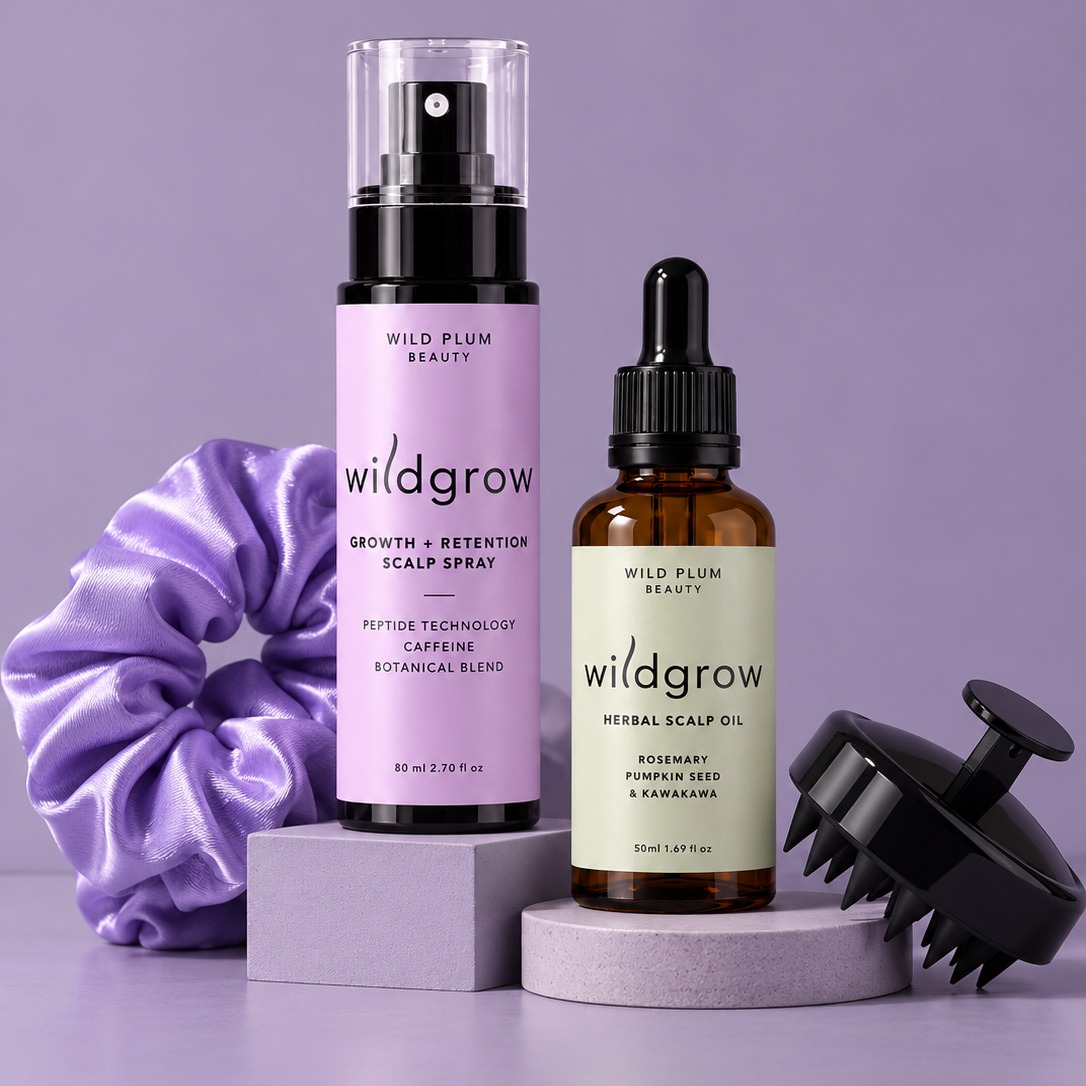
Our Wildgrow range brings together a daily peptide-based scalp spray and a nourishing herbal scalp oil, designed to complement one another as part of a considered scalp-care routine.
If you're interested in exploring a more targeted approach to scalp and hair care, take a look at our [Wildgrow collection] and discover your new scalp-care ritual.
Science meets nature. Let's grow from the roots up.
Ready Set Grow With The Dynamic Growth Duo
Two targeted treatments. One happier scalp. Nature meets science.
Good hair days start at the roots. Meet your new scalp-care ritual: two hardworking treatments designed to nourish the scalp, care for your strands and support the conditions associated with healthy, fuller looking hair.
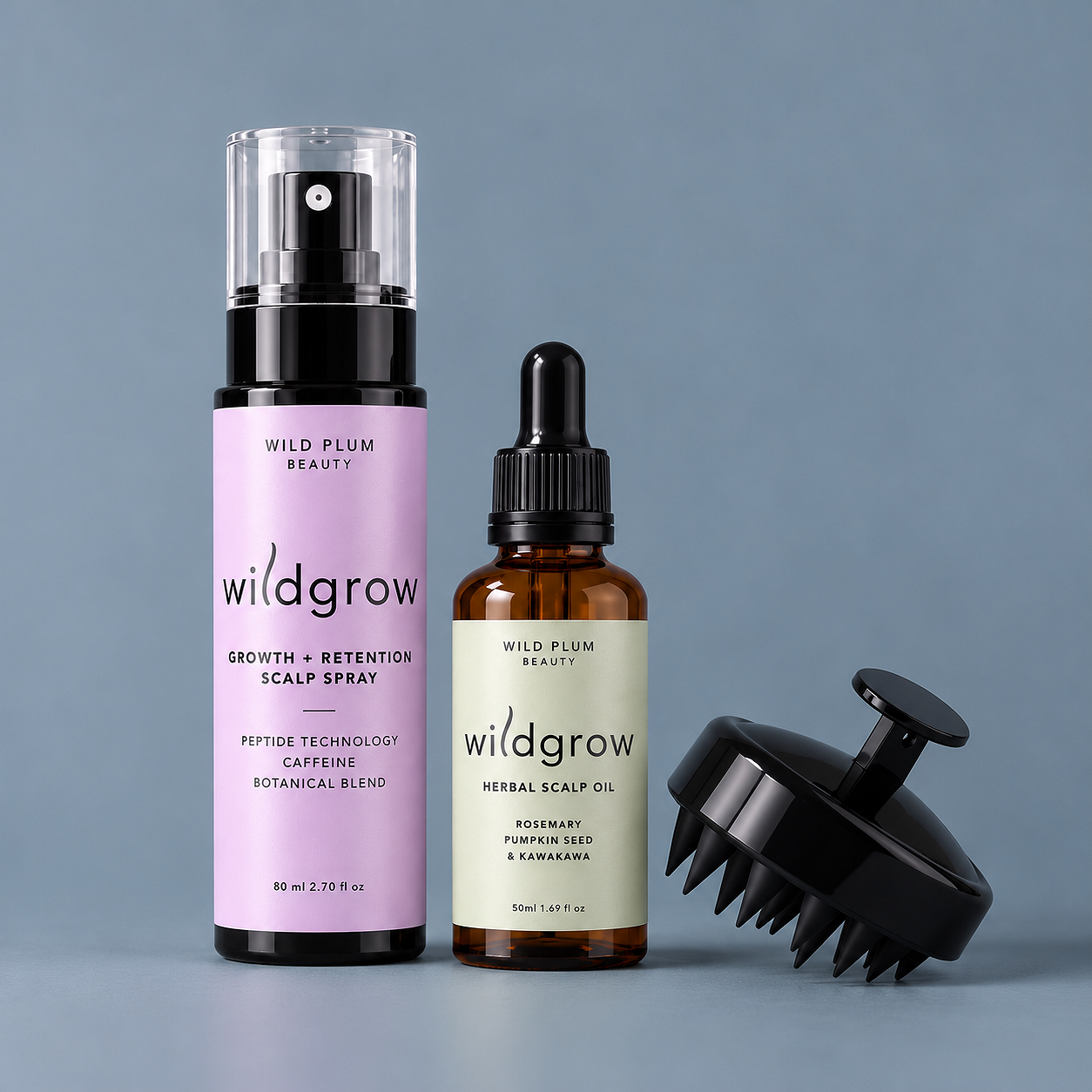
The Wildgrow Dynamic Growth Duo pairs our Peptide Growth & Retention Scalp Spray with our Herbal Scalp Oil for a complementary approach to scalp care. Think targeted cosmetic actives on one side, nourishing botanical oils on the other. Different jobs, same goal: a well-cared-for scalp and stronger hair.
And because good hair care should feel good, too, expect a lightweight daily spray and a sensorial oil treatment with a soft lavender and vanilla scent.
What is Included
01. Wildgrow Peptide Growth & Retention Scalp Spray | 80ml
Your everyday scalp-care essential.
This lightweight, leave-in formula combines targeted peptides, caffeine, niacinamide and panthenol with a botanical blend featuring rosemary, ginseng and red clover.
Peptide technology: Acetyl Tetrapeptide-3 and GHK-Cu help support a well-maintained scalp environment and healthier-looking hair that can grow longer and help reduce shedding
Caffeine: A popular ingredient in scalp-care formulations designed to increase circulation and bring nutrients to the hair follicle to assist new growth
Niacinamide + panthenol: Help maintain scalp hydration and support the skin barrier.
Botanical blend: Adds plant-derived ingredients to help with growth stimulation and hair retention.
Designed for regular use without the rich feel of an oil, this is the step that keeps your scalp-care routine going between wash days.
02. Wildgrow Herbal Scalp Oil | 50ml
Your weekly roots-and-lengths reset.
This lightweight botanical oil treatment blends rosemary and New Zealand kawakawa with nourishing oils, including pumpkin seed, black seed, Abyssinian, camellia, jojoba and meadowfoam. Coconut oil helps condition the hair shaft, while the carefully selected oils help soften strands, improve slip and leave hair feeling smoother and more manageable.
Rosemary + kawakawa: Botanical ingredients chosen for a scalp-focused care ritual.
Pumpkin seed + black seed oils: Add nourishing lipids to your scalp and hair routine.
Abyssinian + coconut oils: Help condition the hair, smooth the lengths and reduce the feel of dryness.
Lavender + vanilla scent: Turns pre-wash care into a little moment of calm.
Massage it in, let the oils do their conditioning work, then shampoo thoroughly. Your scalp gets a little extra attention, and your lengths get some love, too.
Why use them together?
Healthy-looking hair is about more than one ingredient or one product. Your scalp and your strands have different needs, so this duo takes a two-part approach.
The spray delivers lightweight, leave-in care with peptides, caffeine and hydration-supporting ingredients. The oil provides a richer pre-wash treatment to nourish the scalp and condition the hair.
Together, they help you build a consistent routine focused on scalp comfort, strand care and the appearance of fuller, healthier-looking hair. Neither product promises overnight miracles; consistency and a well-maintained scalp are the name of the game.
Your Wildgrow routine
Daily or every other day - The spray
Shake well.
Spray directly onto the scalp, concentrating on the roots and hairline.
Massage gently to stimulate blood flow to the scalp
Leave in. Use on dry or damp hair.
Once or twice a week - The oil
Apply to the scalp in sections and massage gently.
Work a small amount through the lengths and ends if they need extra conditioning.
Leave on for at least two hours before washing, or use as an overnight pre-wash treatment if comfortable for your scalp.
Shampoo thoroughly to remove the oil. A second shampoo may be helpful if needed.
The wash-day reminder
Don't let your scalp-care routine become a build-up routine. Aim to wash your hair every 2–3 days, adjusting to your scalp, hair type, activity level and product use. Regular cleansing helps remove excess oil, sweat, dead skin cells and styling residue so your scalp stays fresh and comfortable.
The little extras
Your Dynamic Growth Duo also comes with a free satin scrunchie and silicone scalp massager two thoughtful additions to make your routine feel that bit more special.
Nature meets science. Good things start at the roots.
For cosmetic use only. Individual results vary. These products are designed to support scalp care and the appearance of healthier-looking hair; they are not intended to diagnose, treat or prevent hair loss or any medical condition. Patch test before first use and discontinue use if irritation occurs.